



Bucharest declaration: NATO's Ukraine debate still haunted by 2008 summit
World
Bucharest declaration: NATO's Ukraine debate still haunted by 2008 summit
VILNIUS (Reuters) - As NATO nations try to agree on Ukraine’s push for membership at a summit in Vilnius this week, an earlier gathering casts a long shadow.
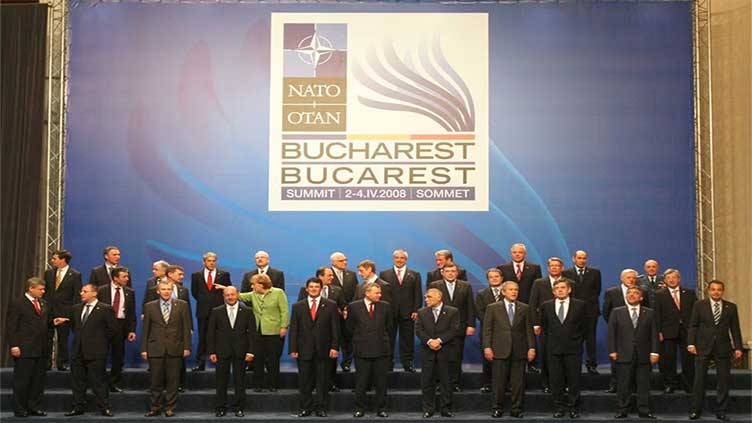
At a summit in Bucharest in April 2008, NATO declared that both Ukraine and Georgia would join the U.S.-led defence alliance - but gave them no plan for how to get there.
The declaration papered over cracks between the United States, which wanted to admit both countries, and France and Germany, which feared that would antagonise Russia.
While it may have been an artful diplomatic compromise, some analysts see it as the worst of both worlds: It served notice to Moscow that two countries it once ruled as part of the Soviet Union would join NATO - but brought them no closer to the protection that comes with membership.
Now, President Volodymyr Zelenskiy is pressing NATO to make clear how and when Ukraine can join, after the war triggered by Russia’s invasion is over.
Once again, there are divisions within NATO. And officials often cite the Bucharest declaration as a reference point.
There is widespread agreement that NATO should move "beyond Bucharest", and not just restate that Ukraine will join one day. But there are substantial differences over how far to go.
This time, the United States and Germany have been the most reluctant to support anything that could be seen as an invitation or a process leading to membership automatically.
Meanwhile, Eastern European NATO members, all of which spent decades under Moscow's control in the last century, are pushing for Kyiv to get a clear road map, with some backing from France.
Although Ukrainian Foreign Minister Dmytro Kuleba announced on Monday that a series of formal conditions for membership had been removed, the Vilnius declaration will inevitably be another compromise.
Assertions that "Ukraine’s rightful place is in NATO" and that it will join "when conditions allow" are among the phrases being discussed, diplomats say, as officials try to find wording acceptable to all NATO’s 31 members. It may end up, as in Bucharest, being left to the leaders to resolve.
The parallels with the 2008 summit, held in the colossal Parliament Palace commissioned by Romanian communist dictator Nicolae Ceausescu, have struck many NATO-watchers.
Orysia Lutsevych, a Ukraine policy expert at the Chatham House think tank, said Zelenskiy and his advisers were working to secure as unambiguous an outcome as possible for Kyiv this time.
"The Bucharest summit left a lot of bad aftertaste and actually created the strategic ambiguity ... the permanent NATO waiting room for Ukraine and Georgia," she said.
